Sharing the road in Hyderabad: autos, buses, two-wheelers, cyclists and pedestrians
How to share the road with autos, city buses, two-wheelers, cyclists, pedestrians and cattle in Hyderabad: gaps, horn use and driving predictably.
Sharing the road in Hyderabad means sharing it with almost everything: autos, city buses, two-wheelers on both sides of you, cyclists, people on foot and, now and then, a cow. You cannot control any of them, but you can give them space, be easy to read and avoid surprises.
The basic idea: space and predictability
Mixed traffic works because most people watch each other and adjust. It goes wrong when someone does something nobody expected: a sudden lane change, a hard stop with no reason, a turn without a signal. So the two most useful habits are simple.
- Leave a gap you could stop in. Behind anything that might stop suddenly, which in this city is almost everything, leave more room than feels necessary. The space in front of you is the only space you control.
- Do things slowly and signal them early. Indicate before you move, not as you move. Change position gradually, so the rider beside you sees the car drifting and has time to react.
Our guide to indicators and lane discipline goes into the signalling side in more detail.
Autos
Auto-rickshaws are small, light and nimble. They turn in a tight space, fit through gaps a car cannot, and stop wherever someone waves at them. That makes them hard to predict.
- Expect a stop at any moment. An auto with a passenger looking out, or an empty auto slowing near a group of people, is about to pull over. Hang back.
- Watch the front wheel. An auto's single front wheel shows its intention early. When it turns, the auto turns, often sharply.
- Do not squeeze them. Autos are easily unsettled by a car passing close. Give them the same room you would give a two-wheeler.
- Look for autos waiting at junctions and stands. They pull out into small gaps. Be ready for one to nose out in front of you.
City buses and lorries
TGSRTC city buses (many people still call them TSRTC buses) are long, heavy and slow to stop. Their drivers cannot see everything around them.
When a bus stops
Buses pull in to stops, and sometimes stop short of them in traffic. When one does, people step off into the road, and others run across to catch it. Slow right down as you approach a stopped bus, and look under and around it for feet and for anyone stepping out from its front. Only pass when you can see the road ahead and leave a good margin.
When a bus pulls out
A bus leaving a stop swings out across the lane. If it has signalled and started to move, let it go. You will lose a few seconds; arguing with a bus is a fight you do not want to win.
Blind spots and turning
Do not sit right beside the back corner of a bus or lorry, and do not try to go up its inside as it turns left. Long vehicles cut in at the back as they turn, and the gap closes quickly. If you cannot see the driver's mirror, the driver probably cannot see you.
Two-wheelers
Scooters and motorbikes are a large share of Hyderabad traffic, and they move differently from cars. They filter between lanes, pass on the left and on the right, move to the front at signals and squeeze through any gap.
- Check mirrors and over your shoulder before every move. Before turning left, especially, look down the left side of the car. A scooter can arrive there in the seconds between your mirror check and your turn.
- Open your door carefully. When parked, look behind before opening the door on either side.
- Do not close a gap to block them. It is tempting, but a rider forced to brake hard in a narrow gap is in danger. Keep your line and let them through.
- Watch for riders who are not watching you. Riders on phones, riders carrying loads or a passenger with a child, and riders looking back over their shoulder all react more slowly.
- Expect wrong-side riders. On some roads, two-wheelers ride against the traffic along the edge to avoid a long U-turn. Look both ways at side roads even on a one-way street.
Cyclists, pedestrians and animals
Cyclists
Cyclists are slower than everything else and often ride close to the edge, where the road is broken or the drain covers are. Pass them wide, not at speed, and do not cut in sharply in front of them to turn left. At night, many bicycles have no lights at all.
Pedestrians
Footpaths are often blocked by parked vehicles, stalls or construction, so people walk in the road. They cross wherever they need to, not just at zebra crossings. Near markets, bus stops, metro stations, schools and places of worship, assume someone will step out. Slow down, make eye contact where you can, and stop for people on a zebra crossing.
Cattle and dogs
Cows and buffaloes still wander on some roads, particularly on the edges of the city and in older neighbourhoods, and stray dogs are common everywhere. Cattle can move slowly and then suddenly. Slow down well before them, pass at a walking pace and do not use a long horn blast, which can make them bolt in any direction.
Using the horn well
The horn is a way of saying "I am here", not "get out of my way". A short tap is useful when someone is about to step or pull out without seeing you, or on a blind bend. Holding the horn down does not make traffic move faster, and it startles the people and animals you most need to stay calm.
Respect no-horn zones, which are signed near hospitals and some schools. And treat a horn from behind as information, not an insult: someone wants you to know they are there.
Practising mixed traffic in Sawari
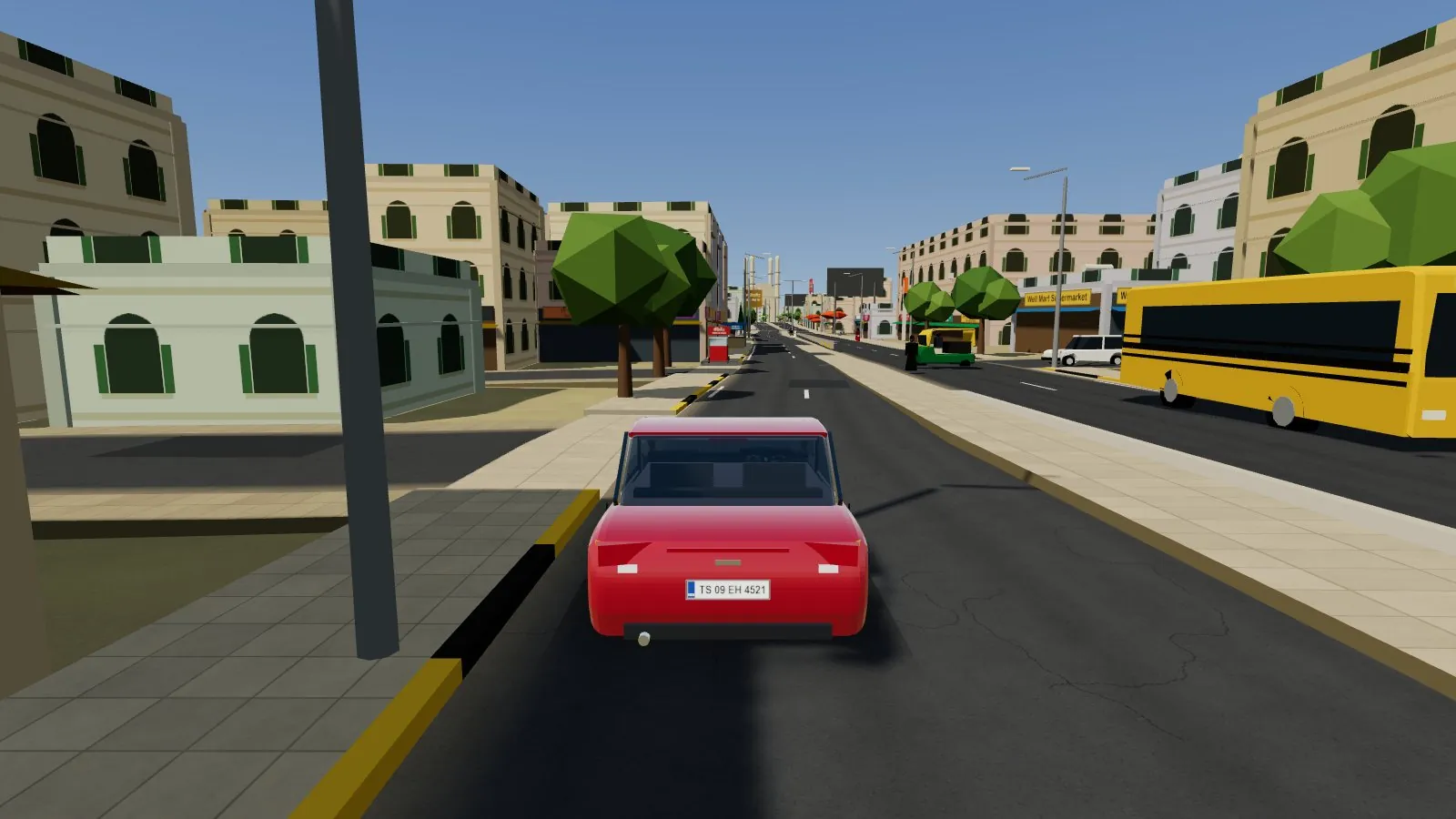
In Sawari you can set the traffic from None to Dense. At Dense there are about 120 vehicles around you, and the mix is drawn from what you see on Hyderabad roads: hatchbacks, sedans, SUVs, autos, mini trucks, buses and a large share of scooters and motorbikes. The features page lists the details.
The two-wheelers filter past slower vehicles on their right, so you will have bikes coming up beside you in queues. The AI drivers keep a following gap, stop at red lights, give way where their paths cross, slow for speed breakers and stop for people stepping across side-road mouths. Now and then one of them has a moment of inattention and there is a real collision ahead, which is a fair test of whether you left enough room. Larger vehicles like buses and lorries keep to the bigger roads.
Pedestrians walk the footpaths and cross the mouths of side roads, and hitting one counts as a collision in your debrief. There is a horn on H and hazard lights on X. The traffic does not move aside for the horn, which is honest: on the real road, it usually does not either.
The game does not include cyclists or animals, so those you have to learn on the road. A good way to start is the Charminar and Pathergatti route with traffic on Medium, then raising it as your gaps and signals become a habit. Our Old City driving guide describes that route.
Frequently asked questions
How do I deal with two-wheelers overtaking on both sides?
Assume there is always a two-wheeler beside you, check your mirrors and over your shoulder before any move, signal early, and change position slowly. Most problems come from sudden moves, not from the bikes themselves.
What should I do when a city bus stops ahead?
Slow down and expect passengers to step off into the road and others to run for the bus. Only pass if you can see the road ahead is clear and you can leave plenty of room, and watch for the bus pulling out again.
Is it rude to use the horn in Hyderabad?
A short tap to let someone know you are there is normal and useful. Long or repeated blasts do not clear the road and only add stress. Do not use the horn in no-horn zones such as near hospitals.
Why do autos stop so suddenly?
Autos pick up and drop passengers wherever they are hailed, so they may brake, swerve to the kerb or turn without much warning. Keep a bigger gap behind an auto than behind a car.
Sawari is a practice simulator. It does not replace lessons with a licensed instructor or the official RTA test. Always follow the signs, signals and traffic police on the real road.