Monsoon driving in Hyderabad: waterlogging, potholes and braking in the rain
Monsoon driving in Hyderabad: handling waterlogged roads and underpasses, hidden potholes, longer braking, aquaplaning and misted glass, and when to stay home.
Monsoon driving in Hyderabad means heavy bursts of rain, roads that turn into streams within minutes, and potholes you cannot see under the water. The safest approach is slower speeds, much bigger gaps, and a willingness to turn back or wait it out.
What the monsoon does to Hyderabad roads
The rains usually arrive in June and can carry on well into October. Hyderabad's heaviest rain often comes in short, intense downpours rather than steady drizzle, and that is what causes the trouble: drains cannot take the water fast enough, and it collects on roads.
- Waterlogging. Low-lying stretches, dips under bridges and roads beside lakes and nalas can fill quickly.
- Underpasses. These are the lowest point of the road by design, so water runs into them. They can go from passable to dangerous in a short time.
- Hidden potholes and open drains. Water hides everything: a pothole, a broken edge, a missing drain cover. Rain also breaks up the road surface, so new potholes appear through the season.
- Slippery surfaces. The first rain after a dry spell lifts oil and dust off the road and makes it very slippery. Painted lines, metal covers and speed breakers are slippery too.
- Traffic jams. Waterlogging on one main road pushes traffic onto others, and journeys can take far longer than usual.
Before you set out
- Ask whether the journey is necessary. In a heavy downpour, waiting an hour is often faster and always safer.
- Check for advisories. The traffic police and city authorities often post waterlogging and diversion updates on their official channels during heavy rain. The Hyderabad Traffic Police is a good place to start.
- Check your wipers. Blades that smear or judder should be replaced before the season, not during it.
- Check your tyres. Worn tread cannot clear water from under the tyre, which is what causes aquaplaning. Check the pressures too.
- Check your lights. In heavy rain you need to be seen. Make sure the headlights, tail lights, brake lights and hazard lights all work.
Driving on wet roads
Slow down and double your gap
On a wet road your tyres have less grip, so it takes much longer to stop. Leave at least twice the gap you would in the dry, and more behind buses and lorries, whose spray blinds you. Brake earlier and more gently.
Be smooth with everything
Sudden braking, sharp steering and hard acceleration are what make a car slide on a wet road. Make every input gentle, and slow down before bends and turns, not in them.
Aquaplaning
When you drive fast through standing water, the tyres can ride up on a film of water and lose contact with the road. The steering suddenly goes light, and the engine may rev as the wheels spin. If it happens:
- Ease off the accelerator. Do not brake hard.
- Hold the steering straight and steady.
- Wait for the tyres to grip again as the car slows; you will feel the steering come back.
The best cure is prevention: slow down well before any patch of water, and avoid driving through puddles at speed.
Visibility: wipers, demisting and lights
- Use your wipers at a speed that keeps the screen clear, and switch on the headlights in heavy rain, even in the day.
- To clear misted glass, turn on the air conditioning and aim the fan at the windscreen, or use the demist setting. A window open a crack also helps.
- Keep the inside of the windscreen clean; a dirty screen mists faster and glares more at night.
- Do not drive with hazard lights on while moving in normal rain, as other drivers cannot see when you signal. Use them if you have stopped or are crawling in very poor visibility.
Rain at night is the hardest combination of all. Our night driving guide covers glare and seeing in the dark.
Look after the people around you
Two-wheeler riders in the rain have poor grip, wet visors and often no protection from your spray. Give them more room, do not splash pedestrians and people waiting at bus stops, and expect people to run across the road to get out of the rain. Our guide to sharing the road has more on two-wheelers and buses.
Waterlogged roads and underpasses
This is where people get into real trouble. Water is heavier and stronger than it looks, and you cannot see what is under it.
- If you cannot see the depth, do not go in. Watch another vehicle like yours cross first. If the water reaches higher than about the middle of its wheels, or you cannot tell, find another way.
- Never enter moving water. Even shallow flowing water can push a car sideways.
- Be very wary of underpasses. If an underpass has water in it during heavy rain, do not drive in. The water in the middle is usually deeper than at the edges, and it can rise while you are inside.
- If you must cross shallow water, go slowly and steadily in first gear, keeping the engine running at a steady speed so water does not get pushed up into the exhaust. Do not stop in the middle. Do not create a bow wave that pushes water into other cars or onto people.
- Test your brakes afterwards. Wet brakes work poorly. Press them gently a few times once you are through, to dry them.
When not to drive
Sometimes the right decision is to stay put. Do not drive if:
- There is a heavy downpour in progress and the trip can wait.
- Authorities have issued a warning to stay indoors or avoid travel.
- Your route depends on an underpass or low road that floods.
- Your wipers, lights or tyres are not in good condition.
- You are new to driving and have never driven on a wet road; start with light rain and an empty road, with an experienced driver beside you.
Practising in Sawari before the rains
To be clear: Sawari has no rain or weather. The roads are always dry, there is no standing water, and grip does not change. You cannot learn aquaplaning or waterlogged roads in it.
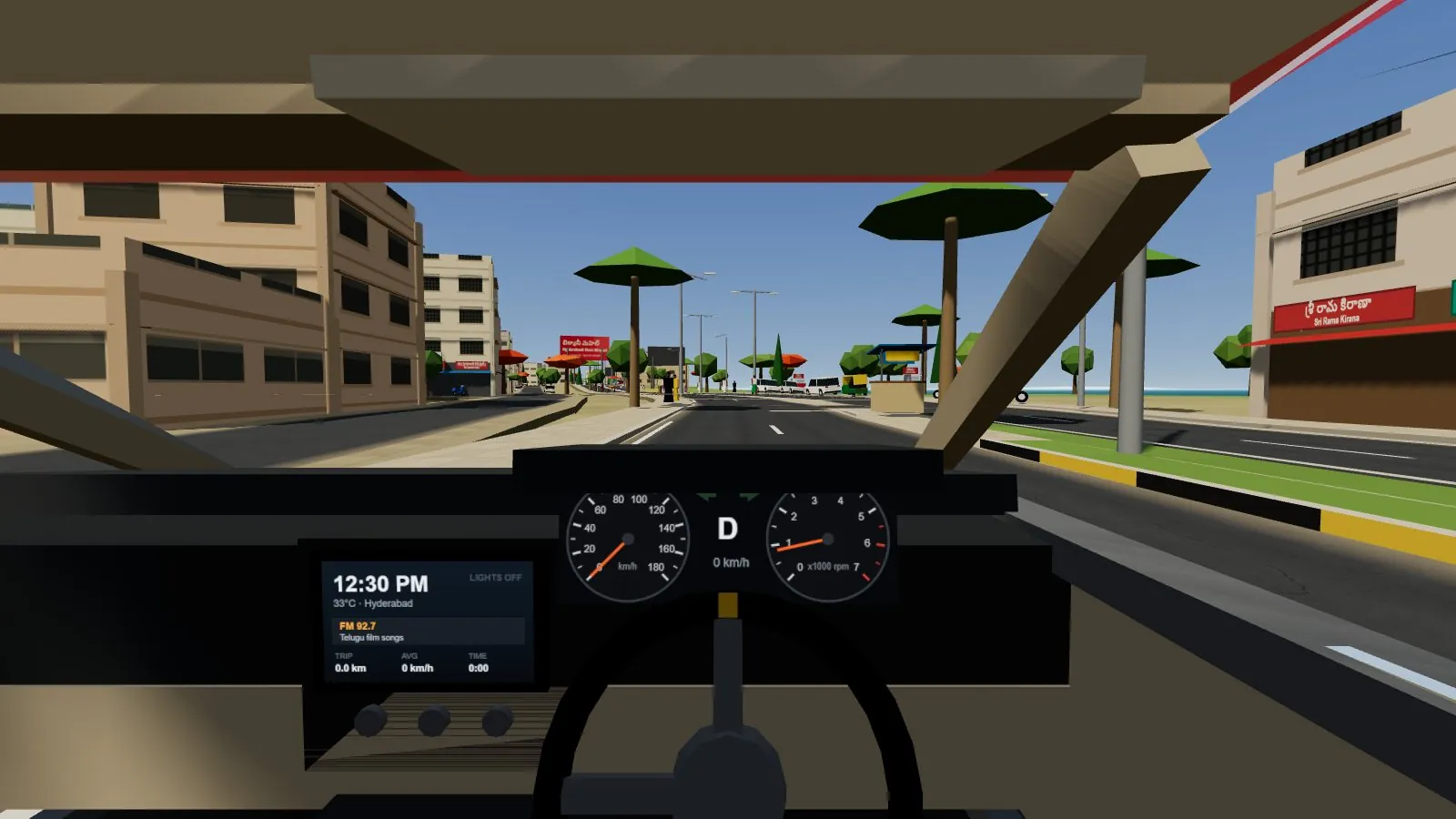
What it can help with is the habits that make wet driving safer: keeping a long gap behind the vehicle in front, braking early and smoothly, signalling before every move and keeping to your lane. The debrief records collisions, speeding, red lights and missed indicators, so you can see which habits need work. Choosing the driver's seat view (C) gives a cockpit view closer to what you see through a real windscreen.
Try a drive with Dense traffic and set yourself a rule of never coming within a long gap of the car ahead. If you can finish a route like Cyber Towers to Jubilee Hills that way with no collisions, you are building the habit that matters most on a wet road.
Frequently asked questions
Is it safe to drive through a flooded road?
Only if you can clearly see how deep it is and it is shallow, ideally by watching a similar car cross first. If you cannot judge the depth, or the water is moving, turn back and find another way.
What should I do if my car stalls in water?
Do not try to restart it, because water drawn into the engine can cause serious damage. Switch on the hazard lights, get out safely if the water is rising, and call for help or a tow.
How do I stop my windscreen misting up in the rain?
Turn on the air conditioning with the fan aimed at the windscreen, or use the demist setting. Opening a window a little also helps, and a clean inside screen mists less.
Does Sawari have rain?
No. The simulator has no rain or weather. It can help you practise gaps, signals and lane discipline, but wet-road driving has to be learnt on the road, carefully.
Sawari is a practice simulator. It does not replace lessons with a licensed instructor or the official RTA test. Always follow the signs, signals and traffic police on the real road.