Speed breakers and speed limits in Hyderabad: how to take humps and read the limit
How to take speed breakers, humps and rumble strips in Hyderabad without damage, spot unmarked ones, and keep to posted speed limits near schools and markets.
Speed breakers are part of almost every drive in Hyderabad, and speed limits change from road to road. The short version: slow down early for humps, roll over them gently, and take your limit from the posted sign rather than from the traffic around you.
Why speed breakers matter so much here
On a main road you may go several kilometres without a hump. Turn into a colony road and you can meet three in a few hundred metres: one just after the junction, one outside a school, one in front of a temple or an apartment gate. They are there because people walk on these roads, children cross them and two-wheelers come out of side lanes without looking.
Taking a breaker too fast does more than shake the passengers. It can scrape the underside of a low car, knock the alignment out, damage tyres and suspension, and on a two-wheeler it can throw the rider. It also tends to happen at exactly the places where people step into the road.
Speed breakers, humps and rumble strips
Speed breakers and humps
Most breakers in the city are a raised hump across the full width of the road. Well-maintained ones are painted with yellow (or white) and black stripes and have a warning sign before them. Some are wide and gentle; others are short and steep, almost like a kerb laid across the road. You cannot always tell which kind it is until you are close, so slow down first and judge it as you approach.
Rumble strips
Rumble strips are groups of low raised bands laid across the lane, usually before a junction, a sharp bend, a toll gate or a stretch where the road changes. You feel a rapid vibration and hear a hum. They are a warning, not a barrier: they are telling you that something ahead needs a lower speed.
Unmarked breakers
The ones that catch people out have no paint and no sign. The stripes may have worn away, the hump may be new, or it may have been put up locally. At night or in the rain, an unpainted breaker is very hard to see. Some clues help:
- Vehicles ahead suddenly dipping, braking or bouncing.
- Two-wheelers moving to the very edge of the road, where some humps are lower or have a gap.
- A slight shadow or ridge across the road surface, especially in low morning or evening sun.
- Schools, hospitals, temples, mosques, colony gates and junctions on residential roads.
How to take a speed breaker properly
- Brake before the hump, not on it. Do your slowing in a straight line while the car is still on flat road. Braking hard on the hump itself pushes the nose down into it.
- Come off the brake just before the front wheels reach it. This lets the front suspension rise and the car rolls over more softly.
- Go over at a crawl, straight on. Keep the steering straight so both front wheels meet the hump at the same time. Taking it at an angle twists the car and is uncomfortable on a steep hump.
- Hold a steady, gentle throttle as the rear wheels cross. Then pick up speed smoothly once you are clear.
- Watch your mirrors and the vehicle behind. Brake progressively so whoever is following has time to slow down too. A sudden stop for a hump you saw late is a common cause of rear-end knocks.
Two-wheelers often ride over the edge of a breaker or squeeze past it near the kerb. Expect them beside you at the hump and leave them room.
Speed limits: read the sign, not the traffic
There is no single speed limit for all of Hyderabad. Different roads carry different limits, and the limit is shown on a round sign with a red border and the number in the middle. That sign is what counts, whatever speed the cars around you are doing.
Some things to keep in mind:
- Limits are lower where people are. Near schools, hospitals, markets and busy shopping streets you will often see lower posted limits, and even where there is no sign, the sensible speed is lower.
- Flyovers and expressways are not a free-for-all. They may carry a higher limit than the road below, but they also have merges, ramps and sudden queues. See our guide to driving on flyovers.
- The limit is a maximum. In heavy traffic, in rain, at night or on a narrow colony road, a safe speed may be well below it.
- Speed is enforced. The traffic police use speed cameras and checks on many roads. Check the Hyderabad Traffic Police website for current rules rather than relying on hearsay.
If you are learning, it helps to get into the habit of glancing for a limit sign every time you join a new road, the same way you check your mirrors. Our Hyderabad traffic rules guide covers the other signs you will meet.
Practising speed breakers and limits in Sawari
Sawari is a free browser driving simulator set on real Hyderabad roads, and it checks both of these habits.
Speed breakers in the game
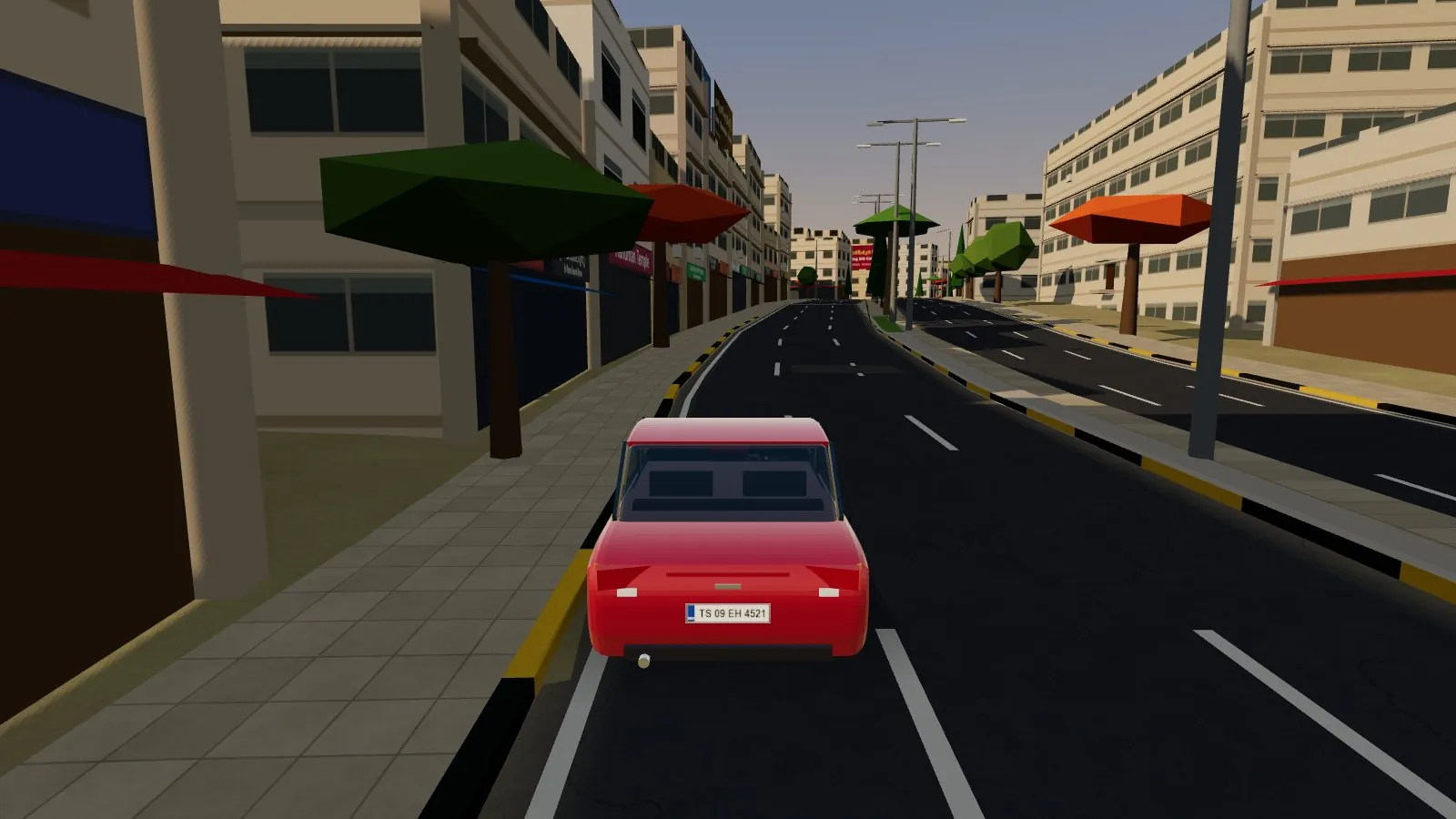
Breakers appear as humps painted in yellow and black stripes across the road, mostly on two-way colony and side roads, often just after a junction. OpenStreetMap has almost none of the city's breakers mapped, so their positions are estimated by rule to match how these roads usually look; the about page explains what is mapped and what is estimated. You feel each one as a jolt through the car.
The game advises taking breakers at about 15 km/h. If you cross one faster than 22 km/h, it is logged as a fault, with your speed, and it appears in your debrief at the end of the drive. The AI traffic slows for breakers too, so you will see cars ahead brake for them, which is a good reminder to look for the cue.
Speed limits in the game
The current limit is shown on the dashboard at the bottom right of the screen. It comes from the maxspeed tag in OpenStreetMap where a road has one; where it does not, the game uses a default for the type of road, lower on residential and service roads than on main roads. These defaults are the game's own choices for practice, not official limits, so on a real road always go by the sign.
Driving more than a few km/h over the limit for a couple of seconds counts as speeding, and the debrief tells you the speed and the limit. A good exercise is to drive a route with the traffic set low and try to finish with no speeding and no breaker faults at all. The Banjara Hills Road No. 1 route, with its climb and side roads, and the narrow streets of the Old City are both useful for this.
Frequently asked questions
How slowly should I go over a speed breaker?
Slow enough that the car rolls over it without a jolt, which for most humps means walking to jogging pace. Sawari suggests about 15 km/h and records a fault above 22 km/h, but a steep or broken breaker may need you to go slower still.
What is the speed limit in Hyderabad?
There is no single figure for the whole city. Limits depend on the road and are shown on posted signs, and they are lower near schools, hospitals and busy markets. Always follow the sign in front of you and the traffic police.
Why are some speed breakers not painted?
Paint wears off, and some humps are built by residents or contractors without markings or warning signs. On colony roads, treat every junction and every school or temple gate as a place where a breaker may be waiting.
Are rumble strips the same as speed breakers?
No. Rumble strips are a series of low raised bands that make the car vibrate and hum to warn you of a hazard ahead, such as a junction or a curve. They are not meant to stop you, but they tell you to slow down.
Sawari is a practice simulator. It does not replace lessons with a licensed instructor or the official RTA test. Always follow the signs, signals and traffic police on the real road.